Situation
Two engagements, one client
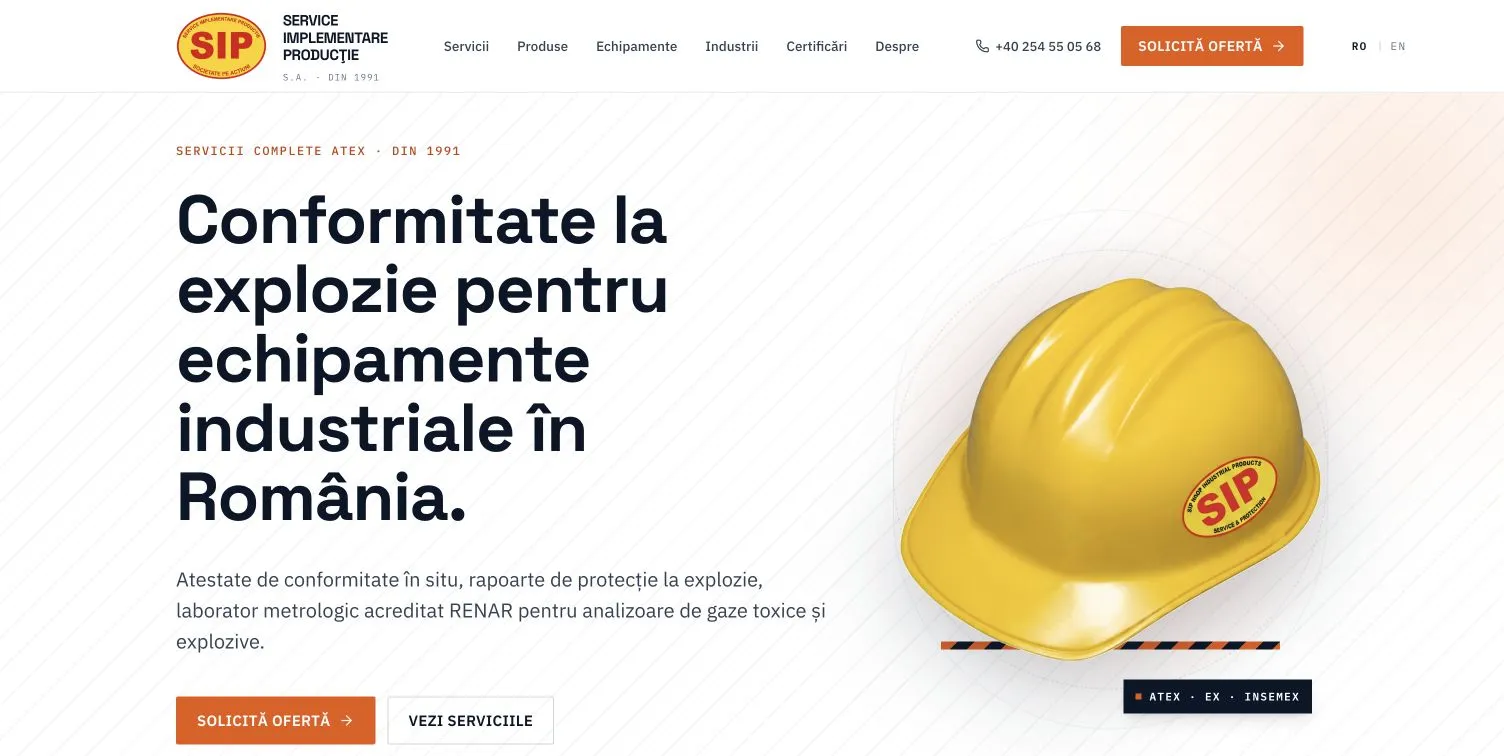
This page covers two distinct workstreams. They are kept apart deliberately, because the screenshot at the top is evidence for one of them and not the other.
- The public website. A shipped site for a compliance business whose buyers arrive looking for a specific certification, service or piece of equipment.
- The legacy recovery. Unsupported Windows XP-era operational software, restored when the source code was no longer available.
Workstream one
A website for a business people buy from carefully
Explosion-protection compliance is not a browsing purchase. A visitor arrives because a piece of equipment needs an ATEX conformity assessment, a gas analyser needs accredited calibration, or an auditor has asked for a document. They need to establish, quickly, that this company is accredited to do that specific thing.
The site is built around that: services, products, equipment, industries served and certifications each get their own route, with the accreditations and the quote request kept permanently in reach. It runs in Romanian and English, because the industrial customer base and the equipment manufacturers behind it do not share a language.
The homepage at the top of this page is that site, live.
Workstream two
A legacy application that stopped writing to its database
A legacy application the company depended on stopped writing to its database. The original source code was not available, so the normal route to a software fix was closed before it started. There was no project to open, correct, rebuild and redeploy.
The choice was between abandoning a system the business still ran on, or working directly on the compiled program. We did the second.
Stabilising the existing application bought the business time to plan its next move without turning a software failure into an emergency replacement project.
How the recovery worked
Investigate, patch, deploy
- Investigate The compiled executable was examined at binary and hex level, because there was no source project to open.
- Patch A fix was produced against the binary itself, without recompiling from source that no longer existed.
- Deploy The patched application was rolled out across the affected computers and returned to normal use.
The recovery moved from investigation to a tested patch and deployment across the affected computers.
Evidence
Two delivered workstreams
- The public website is live and can be inspected directly. The screenshot at the top is its homepage.
- The legacy application was investigated at binary and hex level, patched without source code, and the patch was deployed across the affected computers.
- The two workstreams are separate engagements; neither is evidence for the other.
Our role
Who built it
Both workstreams were delivered by VM Software Lab. S.I.P. Petroșani has approved being named; sensitive operational detail from the recovery remains private.